EV charging videos
10 short films, each under a minute, that answer the questions EV drivers ask most: which charger to use, how long charging takes, what it costs, which plug fits, and how to find chargers that work. Every film has English captions and a full transcript on its page.
-
How to Find EV Chargers That Actually Work 68% of EV drivers hit a broken charger in a single year (Plug In America survey). Three filters fix that: speed, plug and freshness. Watch on: ChargingNear.me home
-
Level 1 vs Level 2 vs Level 3 (DC Fast) EV Charging, Explained Level 1 adds about 5 miles of range per hour, Level 2 about 25, and DC fast charging (often called Level 3) about 100 to 200+ miles in 30 minutes, according to the U.S. Department of Energy. Watch on: EV Charging Levels Explained: Level 1, Level 2, and DC Fast Charging
-
How Long Does It Take to Charge an Electric Car? Real Answers Charging an electric car takes anywhere from under 20 minutes on a DC fast charger to 20 hours or more on a regular wall outlet, according to the U.S. Department of Energy. Watch on: How Long Does It Take to Charge an Electric Car? (Level 1, 2 & DC Fast)
-
How Much Does It Cost to Charge an EV at a Public Charger? Public EV charging cost = kilowatt-hours added × price per kWh. Adding 36 kWh (about 20% to 80% of a 60 kWh battery) costs about $12.60 at 35 cents per kWh and about $19.80 at 55 cents. Watch on: How Much Does Public EV Charging Cost? Per-kWh & Per-Minute Pricing
-
Can Non-Teslas Use Tesla Superchargers? NACS Adapters Explained Yes, many non-Tesla EVs can now charge at Tesla Superchargers. Cars with a built-in NACS port plug straight in. CCS cars need a DC adapter from Tesla or their automaker, and Tesla prohibits third-party adapters. Watch on: Can Non-Teslas Use Superchargers? NACS Adapters Explained
-
How to Find Free EV Charging Stations Near You Free EV charging is usually Level 2, offered as a perk at hotels, grocery stores, shopping centers, workplaces, libraries, city buildings and some car dealerships. Watch on: Free EV charging near me
-
How to Plan an EV Road Trip: Charging Stops Made Simple To plan an EV road trip, plan the charging stops, not just the route. Use your real highway range, arrive with 10 to 20% and leave around 80%, keep a backup charger for every stop, and precondition your battery in the cold. Watch on: EV trip planner
-
EV Plug Types Explained: J1772, CCS, NACS and CHAdeMO There are four EV plug types in the U.S.: J1772 (the standard Level 2 plug), CCS (J1772 plus two DC pins for fast charging), NACS (the North American Charging Standard, being standardized as SAE J3400, for Level 2 and DC fast) and CHAdeMO (an older fast-charging plug). Watch on: EV Connector Types: CCS, CHAdeMO, NACS, J1772 — Complete Guide
-
Why Does EV Charging Slow Down After 80%? Fast Charging Explained EV fast charging slows down after about 80% to protect the battery. Cells take the most power when they're low and taper as they fill, so the last 20% can take as long as the first 80%. Watch on: EV Charging Speeds Explained: kW, Miles-Per-Hour & Charge Curves
-
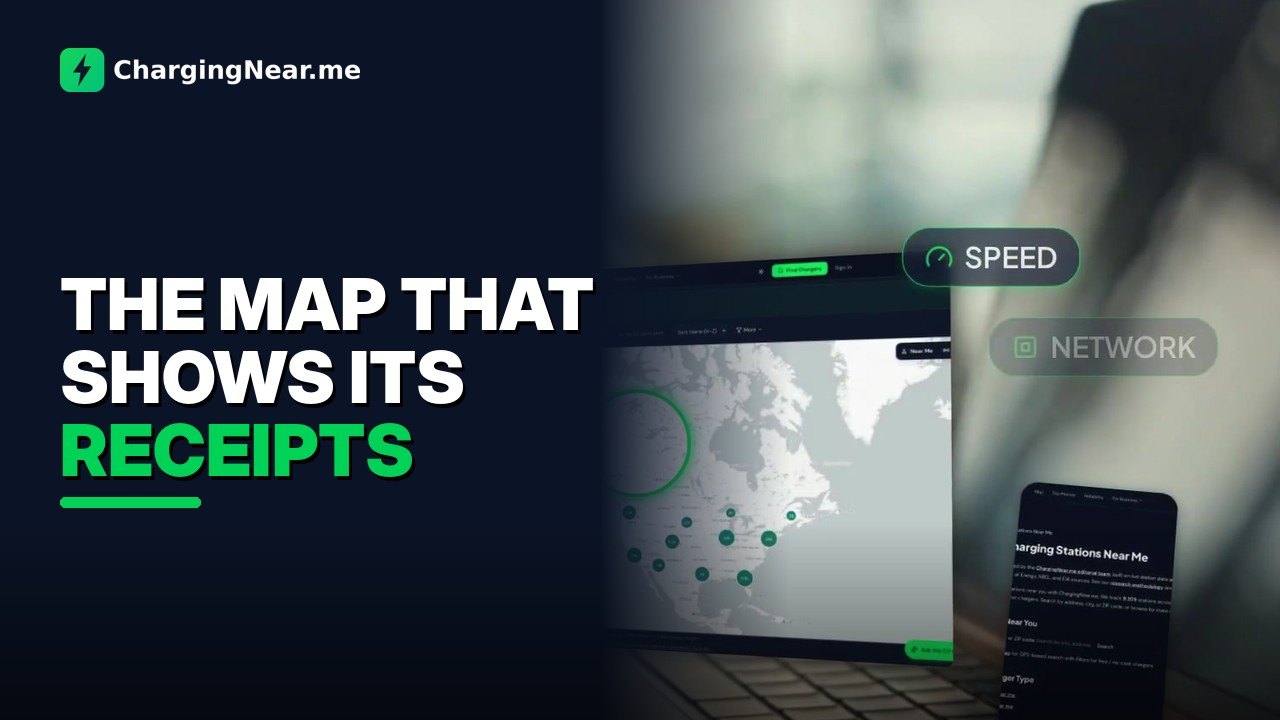
The EV Charging Map That Shows Its Receipts ChargingNear.me is a free EV charging map that shows its receipts. Every station page shows the date it was last verified, station data syncs daily from the U.S. Department of Energy, new stations land on a recently-added page, and drivers can check in or flag broken chargers. Watch on: Our methodology